
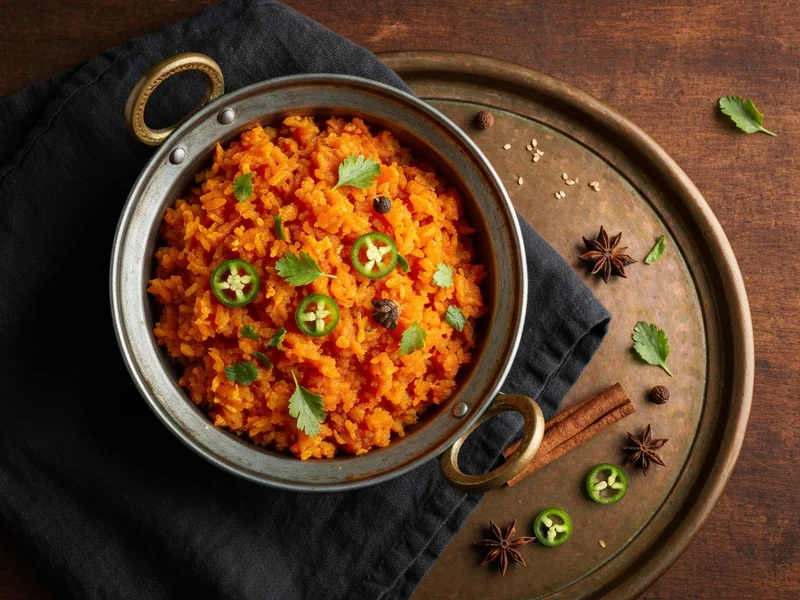
Punjab cuisine
Gajar Ka Halwa — Classic Pakistani Carrot Dessert
Gajar Ka Halwa — Classic Pakistani Carrot Dessert is a traditional Punjab Pakistani dish. Gajar ka halwa is Pakistan's most beloved winter dessert — slow-cooked grated carrots in full-fat milk, sugar, and cardamom, finished with a shower of nuts and a knob of ghee. Rich, aromatic, and impossibly comforting, it turns a humble root vegetable into something genuinely spectacular.
When the temperature drops in Lahore, two things happen: everyone complains loudly about the cold, and enormous deghs (heavy-bottomed pots) of gajar ka halwa appear on every kitchen stove.
The dish migrated from royal courts to every home across the subcontinent, and today it is as much a part of Pakistani winter as fog, shawls, and weddings. The magic is in the patience — low heat, slow evaporation, and time transform the grated gajar (carrot) into a jammy, deeply flavoured halwa. Diaspora note: Pakistani red carrots (gajar) are sweeter and less watery than the orange ones abroad — if you can find them at a desi grocery, grab them. If not, add a tablespoon less sugar.
Ingredients
Instructions
- GRATE THE GAJAR: Wash and peel 1 kg of gajar (carrots) and grate them on the large holes of a box grater or use the grating disc of a food processor. You want long, coarse shreds — not mush. HINT: Wet carrots will take much longer to cook. Pat the grated carrot dry with a clean kitchen cloth if they seem very watery. You should have roughly 6-7 cups of grated carrot. The smell is already sweet and earthy — that's a good sign.
- COOK IN MILK: In a bhari degh (heavy-bottomed pot) or large pateela (saucepan), add the grated gajar and pour in 1 litre of full-fat doodh (milk). Bring to a boil on high heat, stirring frequently with a chamcha (ladle) so the milk doesn't scorch on the bottom. Once boiling, reduce heat to medium-low. HINT: Never walk away from simmering milk — it boils over without warning and makes a mess your mother will not forgive. The mixture will turn bright orange-red and smell wonderfully sweet and milky.
- THE LONG SIMMER: Now begins the meditation. Cook the carrot-milk mixture on medium-low heat, stirring every 5-7 minutes, for 45-60 minutes. You are waiting for all the doodh to be absorbed into the gajar. The mixture will go from a runny orange soup to a thick, jammy mass. FUN FACT: Traditional Pakistani halwais (sweet makers) cook gajar ka halwa in enormous deghs over wood fire, stirring for hours — the slight smokiness is actually a feature. The smell in your kitchen should shift from milky to caramelised and intensely carrot-y. HINT: Don't rush this with high heat — you'll scorch the bottom and the halwa will taste bitter.
- ADD GHEE AND SUGAR: Once the milk has fully evaporated and the mixture looks thick and jammy with no visible liquid, add 2 tbsp of ghee (clarified butter) and stir it through. Add the cheeni (sugar) and the freshly ground elaichi (cardamom) powder. Stir well. HINT: The sugar will immediately release more liquid from the carrots — don't panic. Keep cooking and stirring on medium heat. Within 10-15 minutes, this liquid will evaporate and the halwa will come together again, now darker and richer.
- ADD KHOYA: Once the sugar liquid has dried up and the halwa looks shiny and cohesive, crumble in the khoya (dried milk solids). Stir vigorously — the khoya will melt in and make the halwa incredibly rich and fudgy. Cook for another 5 minutes. If using saffron milk, drizzle it in now. The halwa should now be deep reddish-orange, pulling away from the sides of the degh, and smelling of cardamom and caramelised milk. HINT: If it looks dry before khoya melts in, add 1 more tbsp ghee.
- FINISH AND GARNISH: Turn off the heat. Stir in the remaining 2 tbsp ghee — this last addition gives the halwa a beautiful gloss and keeps it from drying out as it cools. Taste for sweetness; you can add more cheeni now if needed. Transfer to a serving bartan (bowl) and top with slivered badam (almonds), chopped pista (pistachios), and plumped kismish (raisins). Serve hot — the fragrance alone will empty your living room faster than calling for dinner.
Essential for This Recipe
As an Amazon Associate, we earn from qualifying purchases
Pure Ghee (Clarified Butter)
The authentic cooking fat for Pakistani dishes — adds rich flavor that oil can't match
Green Cardamom Pods (Elaichi)
The fragrant heart of biryanis, pulaos, chai, and desserts — use whole pods for best flavor
Saffron Threads (Zafran)
The luxury spice for biryanis, zarda, kheer, and special occasions — adds golden color and floral elegance
Chef's Secrets
- Grate carrots just before cooking — pre-grated carrots sitting in the fridge release moisture and take longer to cook.
- Use a heavy-bottomed degh or pot — thin pans cause the milk to scorch on the bottom and ruin the flavour.
- Gajar ka halwa tastes even better the next day as the flavours deepen. Reheat with a splash of milk and a tsp of ghee to loosen it up.
- For weddings or large batches, pre-cook the carrots in milk in a pressure cooker for 15 minutes, then transfer to a wide pan to dry out — saves an hour of stirring.
- If you can find Pakistani laal gajar (red carrots) in winter at a desi grocery store, use them — the colour and flavour are genuinely superior to orange carrots.
- Don't substitute ghee with regular cooking oil — the flavour difference is massive. If avoiding dairy, use coconut oil but know it will taste different.
Common Questions
How long does Gajar Ka Halwa — Classic Pakistani Carrot Dessert take to make?
Total time is 1h 40m — 20m prep and 1h 20m cooking.
How many servings does this recipe make?
This recipe makes 6 servings, and is rated medium difficulty.
Which region of Pakistan is Gajar Ka Halwa — Classic Pakistani Carrot Dessert from?
Gajar Ka Halwa — Classic Pakistani Carrot Dessert is from Punjab, Pakistan — one of the country's most distinctive culinary traditions.
What do you serve with Gajar Ka Halwa — Classic Pakistani Carrot Dessert?
Serve hot on its own or with a scoop of vanilla ice cream for a modern twist. At weddings it's served warm in small katoris (bowls) as the dessert course. Pairs beautifully with a cup of doodh pati chai.
Goes Well With

Gajar Ka Halwa — Quick Stovetop Version
Quick stovetop gajar ka halwa made with juicy red carrots grated and cooked with whole milk, sugar and ghee until thick and fudgy, finished with cardamom and nuts. Ready in 45 minutes instead of hours — all the halwai flavour, fraction of the time.
Sheer Khurma
The Eid morning vermicelli pudding — toasted sevaiyan simmered in sweetened milk with dates, pistachios, almonds, and cardamom. No Eid is complete without it.
Doodh Chawal Kheer — Pakistani Rice Pudding
Kheer is the quintessential Pakistani celebration dessert — rice slow-cooked in full-fat milk until creamy and thick, perfumed with cardamom and saffron, and crowned with pistachios and silver leaf. It appears at every eid, wedding, and birth celebration across the country.
Cite This Recipe
Writing about Pakistani food? Use these ready-made citations.
<a href="https://pakistani.recipes/recipes/kheer/doodh-chawal-kheer/">Doodh Chawal Kheer — Pakistani Rice Pudding</a> — Pakistani Recipes
Ayesha Noor. "Doodh Chawal Kheer — Pakistani Rice Pudding." Pakistani Recipes, 2024. https://pakistani.recipes/recipes/kheer/doodh-chawal-kheer/
Ayesha Noor. (2024). Doodh Chawal Kheer — Pakistani Rice Pudding. Pakistani Recipes. Retrieved 2026-07-20, from https://pakistani.recipes/recipes/kheer/doodh-chawal-kheer/
What Cooks Are Saying
Incredible depth of flavour. The spice balance is just right — not too hot, not too mild.
Made this last weekend and the whole family loved it. Will definitely make again.