
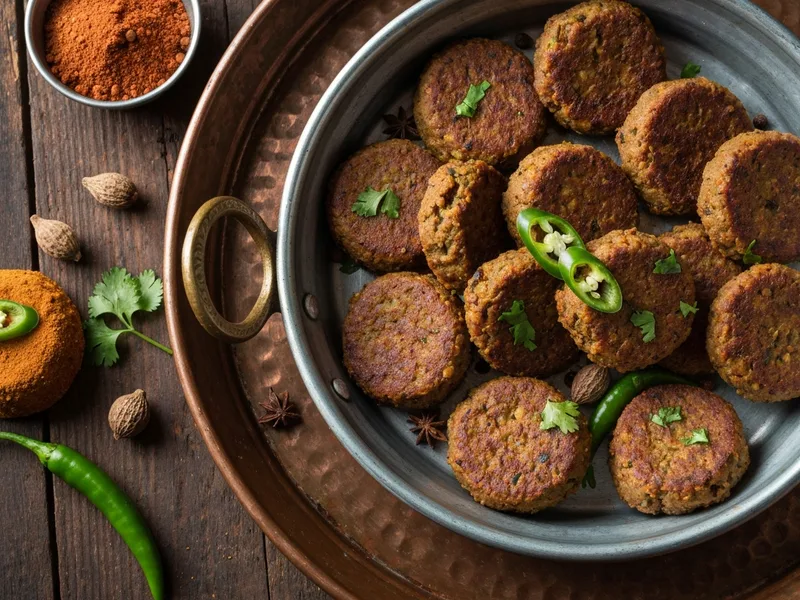
Balochistan cuisine
Khaddi Kabab
Khaddi Kabab is a traditional Balochistan Pakistani dish. Balochistan's most spectacular dish — a whole lamb heavily marinated in a yoghurt-spice paste, then slow-roasted in a sealed earthen pit with hot coals. The animal is suspended ABOVE the coals on a spit, the pit is covered, and 4-6 hours of indirect heat bastes the meat. The belly stuffing of rice, dried fruits, and nuts is authentic tradition, not an embellishment.
Khaddi Kabab is the crown jewel of Balochi cooking. A pit (khaddi) is dug in raw earth — not clay-lined — and kandi hardwood is burned down to hot coals. The whole animal, heavily marinated in yoghurt and spices, is skewered on a metal spit and suspended ABOVE the coal bed (not buried in it). The pit is covered with a metal sheet, more coals placed on top, and the animal cooks by indirect heat from below and above for 4-6 hours. The belly is stuffed with partially cooked rice, dried fruits, almonds, cashews, and raisins.
Ingredients
Instructions
- MAKE THE MARINADE: In a large bowl, combine the dahi (yoghurt), adrak-lehsun paste (ginger-garlic paste), namak (salt), lal mirch powder (red chilli powder), and sarson ka tel (mustard oil). Whisk until smooth and combined. HINT: If the yoghurt is very thick, add 2 tablespoons of water to loosen it — you want a paste that coats the meat, not a batter that slides off.
- MARINATE THE MEAT: Score the meat deeply with a sharp knife — make cuts about 2-3cm deep all over the surface, especially near the bone. WHY: These cuts allow the marinade to penetrate past the surface and season the meat all the way through during the long cook. Rub the marinade aggressively into every cut, every surface, every crevice. Add the whole spices (badi elaichi, laung, kali mirch, darchini, zeera) into the bowl and toss everything together. Cover and refrigerate for a minimum of 4 hours — overnight is ideal.
- BRING TO ROOM TEMPERATURE: Remove the marinated meat from the fridge 1 hour before cooking. WHY: Cold meat placed into a sealed vessel takes much longer to come up to temperature, resulting in uneven cooking — the outside is done while the inside near the bone is still tough. Room-temperature meat cooks evenly.
- PREPARE THE SEALING DOUGH: Mix 1 cup of atta (whole wheat flour) with just enough pani (water) to make a stiff, pliable dough — stiffer than bread dough, almost like clay. You are not cooking this dough; you are using it as an airtight gasket. Roll it into a long rope about 1cm thick. Set aside. HINT: The dough rope should be long enough to go around the rim of your pot in one complete loop.
- LOAD THE VESSEL: Transfer the marinated meat and all the marinade into your Dutch oven, clay matka (clay pot), or the heaviest, most oven-safe pot you own with a tight lid. Pack the meat in — it is fine if it is snug. Do not add any water. The marinade and the meat's own moisture is enough.
- SEAL THE LID: Place the lid on top. Press the dough rope firmly around the seam where the lid meets the pot, all the way around, creating a complete seal. Press the dough into the gap — it should be air-tight. FUN FACT: This sealing technique is called 'dum' and is the same principle behind the dum pukht (slow-cook) method used across South and Central Asia. The word 'dum' literally means 'breath' — you are trapping the breath of the food inside.
- COOK ON THE STOVETOP FIRST: Place the sealed pot on your stovetop over medium heat for 15 minutes. WHY: Starting on the stovetop gets the pot hot all the way through before transferring to the oven. This avoids a cold-start which can cause the bottom meat to steam-boil in liquid before the heat evens out. You should hear very gentle sizzling inside after 10-12 minutes.
- TRANSFER TO OVEN: Preheat your oven to 150°C (300°F) while the pot is on the stove. After the 15-minute stovetop start, carefully transfer the sealed pot to the middle rack of the oven. Cook for 4 hours undisturbed. HINT: Place the pot on a baking tray — occasionally the seal can weep a little liquid.
- BREAK THE SEAL AND CHECK: After 4 hours, remove the pot from the oven. Using a knife, carefully break the dough seal (it will be very hard and baked). Lift the lid away from you — the steam inside is extremely hot. The meat should look almost impossibly tender, deeply golden on top, sitting in a pool of richly spiced yoghurt broth. A skewer or knife should slide through to the bone with zero resistance. If it doesn't, re-seal with fresh dough and return to the oven for another 45 minutes.
- REST AND SERVE: Do not serve immediately. Let the Khaddi Kabab rest, uncovered, for 10 minutes. This allows the juices to settle back into the meat fibres. The smell filling your kitchen at this point — warm yoghurt, sweet spice, deeply savory meat — is one of the great aromas of Pakistani cooking. Serve the meat on a large platter with the broth spooned over the top.
Essential for This Recipe
As an Amazon Associate, we earn from qualifying purchases
Yogurt Culture/Starter
Make fresh yogurt for raitas and marinades at home — authentic and cheaper than store-bought
Green Cardamom Pods (Elaichi)
The fragrant heart of biryanis, pulaos, chai, and desserts — use whole pods for best flavor
Black Cardamom (Badi Elaichi)
Smoky and bold, essential for biryanis and nihari — gives dishes their distinctive deep character
Whole Cloves (Laung)
Warm, sweet, and aromatic — adds depth to rice dishes, biryanis, and meat curries
Chef's Secrets
- The overnight marinade is not optional for maximum results — yoghurt is a tenderiser and needs time to work, especially near the bone.
- If you have access to a real clay matka (clay pot), use it — the porous clay adds a subtle earthiness that no metal pot can replicate.
- Do not skip the stovetop start before the oven — it makes a real difference to the final texture.
- The baked dough seal is not edible, but it is proof your dum worked. If the dough is pale and soft, the seal failed — your steam escaped and your meat will be drier.
- For a charcoal smoky finish: after removing the lid, place a small foil cup of lit charcoal on top of the meat, drizzle with a drop of ghee, cover loosely for 5 minutes, then remove before serving.
- The exterior marinade is full and complex — Khaddi Kabab uses yoghurt, ginger-garlic, red chilli, coriander, cumin, garam masala, and salt applied 3 hours before. This is different from Rosh (minimalist). Khaddi is the celebration dish; Rosh is the daily dish.
- Belly stuffing: partially cooked basmati rice mixed with onion, coriander, green chillies, almonds, cashews, raisins, dried apricots, pistachios, and salt. Sew the cavity shut. The rice finishes cooking inside the animal using the lamb's own fat during the pit roast. This stuffing is confirmed authentic by Arab News, Google Arts & Culture SOCH, and Pakistan Atlas.
- The animal is suspended ABOVE the coals on a spit — it is not buried. The pit is then covered to create a sealed heat chamber. Think of it as a sealed oven with live coals at both the bottom and top.
Common Questions
How long does Khaddi Kabab take to make?
Total time is 4h 45m — 30m prep and 4h 15m cooking.
How many servings does this recipe make?
This recipe makes 4 servings, and is rated medium difficulty.
Which region of Pakistan is Khaddi Kabab from?
Khaddi Kabab is from Balochistan, Pakistan — one of the country's most distinctive culinary traditions.
What do you serve with Khaddi Kabab?
Serve on a large platter with the cooking juices poured over, alongside thin flatbread or kaak (Balochi hard bread). Sliced raw onion, green chillies, and fresh lemon wedges on the side are traditional. Mint chutney optional but recommended.
Goes Well With
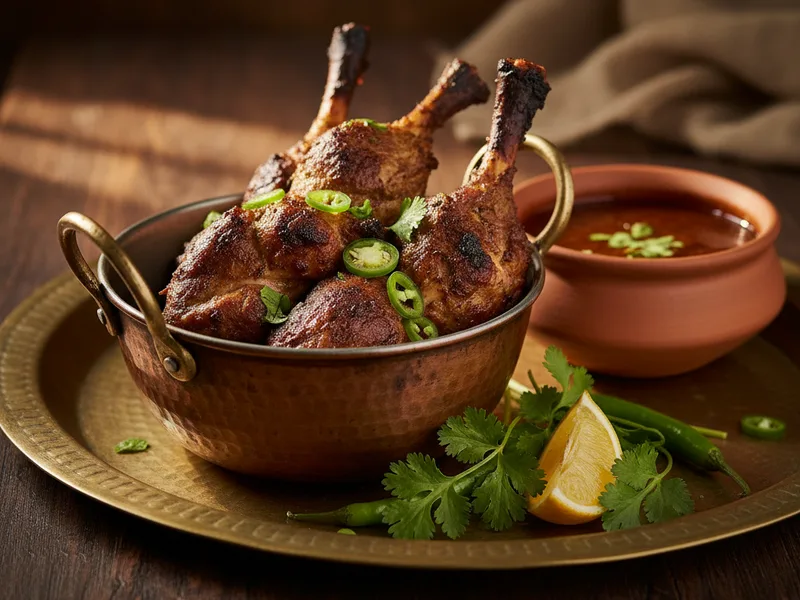
Khaddi Kabab — Underground Earth-Pit Kabab
KP's ancient underground-cooking technique — a whole marinated goat suspended and slow-roasted inside a sealed pit over charcoal for 4-6 hours. This is Pakistani barbecue at its most primal and spectacular.

Chicken Khaddi — Home-Scale Pit-Style
A home-friendly adaptation of KP's underground khaddi cooking technique using whole chicken — marinated in robust Pashtun spices and slow-roasted in a sealed clay pot or dutch oven to capture that signature earth-oven tenderness.

Balochi Sajji — Whole Roasted Chicken
Balochi Sajji is a whole chicken marinated in just salt and basic spices, skewered on a long stick, and slow-roasted vertically over a wood fire until the skin crisps and the meat falls off the bone. This is Balochistan's most iconic dish — minimalist, ancient, and absolutely extraordinary.
Cite This Recipe
Writing about Pakistani food? Use these ready-made citations.
<a href="https://pakistani.recipes/recipes/sajji/balochi-sajji/">Balochi Sajji — Whole Roasted Chicken</a> — Pakistani Recipes
Mir Hassan. "Balochi Sajji — Whole Roasted Chicken." Pakistani Recipes, 2024. https://pakistani.recipes/recipes/sajji/balochi-sajji/
Mir Hassan. (2024). Balochi Sajji — Whole Roasted Chicken. Pakistani Recipes. Retrieved 2026-07-20, from https://pakistani.recipes/recipes/sajji/balochi-sajji/
What Cooks Are Saying
Good recipe, clear instructions. The end result was delicious.
Authentic taste, clear steps. Exactly what I was looking for.
I was nervous to try this but the instructions made it so easy. Turned out amazing.